
The Bhagavad Gita Explained
The Bhagavad Gita is not just a religious book—it is a practical guide for life. For more than two thousand years, it has helped people deal with fear, confusion, moral dilemmas, duty, and the search for meaning. Whether someone is religious, spiritual, or simply curious about philosophy, the Gita speaks in a universal voice.
Often called the “Song of God”, the Bhagavad Gita explains how to live rightly in the world without losing inner peace. It answers questions that are still relevant today:
What should I do when life feels overwhelming?
How do I balance duty, emotions, and personal values?
Is it possible to work, love, and struggle—and still grow spiritually?
What Is the Bhagavad Gita?
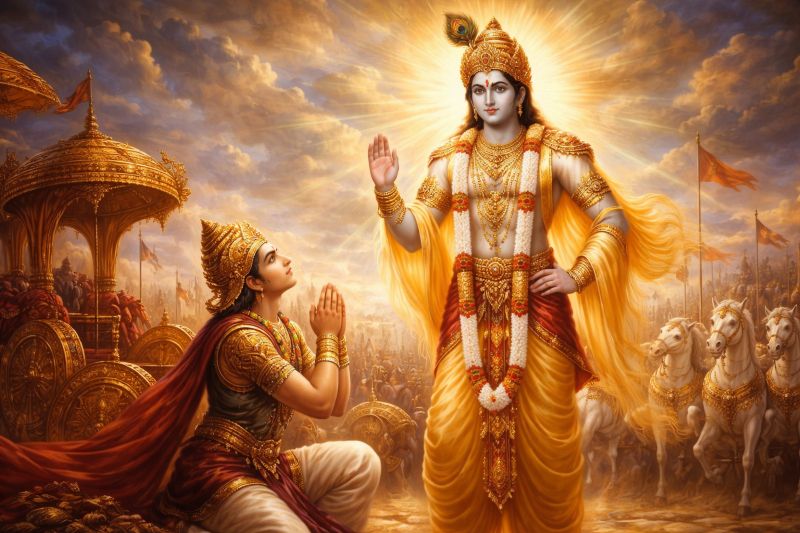
The Bhagavad Gita is a 700-verse Sanskrit scripture that forms part of the Indian epic Mahabharata. It appears in Book 6 (Bhishma Parva) of the epic and is presented as a dialogue between Prince Arjuna and Lord Krishna.
Krishna serves as Arjuna’s charioteer, but in truth He is the divine teacher guiding a confused human being through a crisis of conscience.
Key Facts at a Glance
-
Language: Sanskrit
-
Verses: 700
-
Chapters: 18
-
Part of: Mahabharata (Book 6)
-
Estimated Date: c. 2nd century BCE – 2nd century CE
-
Core Themes: Dharma (duty), Yoga (spiritual discipline), Moksha (liberation)
Historical and Scriptural Context
The Mahabharata tells the story of a dynastic conflict between two families—the Pandavas and the Kauravas. On the battlefield of Kurukshetra, just before war begins, Arjuna is overwhelmed.
He sees teachers, cousins, friends, and elders standing on the opposite side. His hands tremble, his mouth dries, and his famous bow slips from his grip. He asks a deeply human question:
“Is it right to fight, even if the cause is just, when it leads to so much destruction?”
This moment of despair becomes the starting point of the Bhagavad Gita.
The Setting: A Battlefield as a Classroom
One of the most powerful aspects of the Gita is where it takes place—not in a forest or monastery, but in the middle of a battlefield.
This is symbolic:
-
Life itself is a battlefield of choices
-
Moral clarity often arises during crises
-
Spiritual wisdom is meant for active life, not escape
Krishna does not tell Arjuna to run away. Instead, He teaches him how to act without being destroyed by action.
Central Idea: Dharma (Right Duty)
At the heart of the Bhagavad Gita is Dharma—one’s moral responsibility according to situation, role, and conscience.
Krishna explains that:
-
Avoiding duty out of fear is also a form of action
-
True morality is not blind emotion but clarity of purpose
-
One must act according to righteousness, not attachment
📖 Reference: Bhagavad Gita 2.47
“You have a right to perform your duty, but not to the fruits of your actions.”
This single verse has influenced ethics, leadership, and personal development across cultures.
The Three Main Paths (Yogas) of the Gita
The Gita does not promote only one spiritual method. Instead, it recognizes different human temperaments and offers multiple paths, all leading to the same truth.
1. Karma Yoga – The Path of Selfless Action
Karma Yoga teaches:
-
Work is unavoidable
-
What matters is intention and attachment
A Karma Yogi:
-
Performs duties sincerely
-
Does not obsess over success or failure
-
Sees work as service, not ego-expression
Real-life example:
A doctor treating patients honestly, without greed or fame-seeking, practices Karma Yoga—even if they never read a single verse of the Gita.
📖 Reference: Gita Chapters 2–5
2. Bhakti Yoga – The Path of Devotion
Bhakti Yoga focuses on:
-
Love
-
Surrender
-
Relationship with the Divine
Krishna emphasizes that pure devotion transcends caste, class, gender, or background.
📖 Reference: Bhagavad Gita 9.26
“Whoever offers Me with devotion a leaf, a flower, fruit, or water—I accept it.”
This made spirituality accessible to ordinary people, not just scholars or ascetics.
3. Jnana Yoga – The Path of Knowledge
Jnana Yoga is the path of wisdom and self-inquiry.
Key ideas:
-
The body is temporary
-
The soul (Atman) is eternal
-
Ignorance causes suffering
Krishna teaches Arjuna to distinguish between:
-
The changing (body, emotions)
-
The unchanging (self, consciousness)
📖 Reference: Gita Chapter 13
The Universal Form of Krishna (Vishvarupa)
In Chapter 11, Krishna reveals His cosmic form—a moment of awe and terror.
This vision shows:
-
Time destroying all beings
-
Creation and destruction as one process
-
The divine presence behind all events
This chapter confirms that the Gita is both philosophical and deeply mystical.
📖 Reference: Bhagavad Gita Chapter 11
Relationship Between the Gita, Vedas, and Upanishads
The Bhagavad Gita acts as a bridge between:
-
Vedic ritualism (external action)
-
Upanishadic philosophy (inner realization)
It integrates:
-
Sacrifice → Selfless action
-
Knowledge → Practical wisdom
-
Renunciation → Inner detachment, not escape
📖 Reference: Gita 4.33–4.38
Influence Through History
The Gita has inspired thinkers across centuries:
-
Adi Shankaracharya – Non-dual (Advaita) interpretation
-
Ramanujacharya – Devotional (Vishishtadvaita) reading
-
Madhvacharya – Dualistic interpretation
-
Mahatma Gandhi – Manual of selfless action and non-violence
Gandhi called the Gita his “spiritual dictionary.”
Modern Relevance of the Bhagavad Gita
The Gita is widely studied today in:
-
Leadership training
-
Psychology
-
Stress management
-
Ethics and decision-making
In Daily Life:
-
Teaches emotional balance
-
Helps manage anxiety and burnout
-
Encourages responsibility without obsession
Example:
A student facing exam pressure can learn from the Gita to focus on effort, not panic over results.
Is the Bhagavad Gita Only for Hindus?
No. While it is a central Hindu scripture, its teachings are universal.
It addresses:
-
Human fear
-
Moral confusion
-
Purpose of life
That is why it is read worldwide, across religions and cultures.
Authenticity and References
-
Mahabharata, Bhishma Parva
-
Critical editions by BORI (Pune)
-
Traditional commentaries by Shankara, Ramanuja, Madhva
-
Academic dating: 2nd century BCE–2nd century CE (scholarly consensus)
Conclusion: Why the Gita Endures
The Bhagavad Gita survives not because it is ancient, but because it is timeless.
It does not demand blind belief.
It invites reflection, courage, and conscious living.
In a world full of uncertainty, the Gita reminds us:
Do your duty. Act with clarity. Let go of fear.
That is why the Bhagavad Gita remains one of the greatest spiritual classics in human history.