
Table of Contents
ToggleSaints and Gurus of Hindu Dharma: The Eternal Guides of Humanity
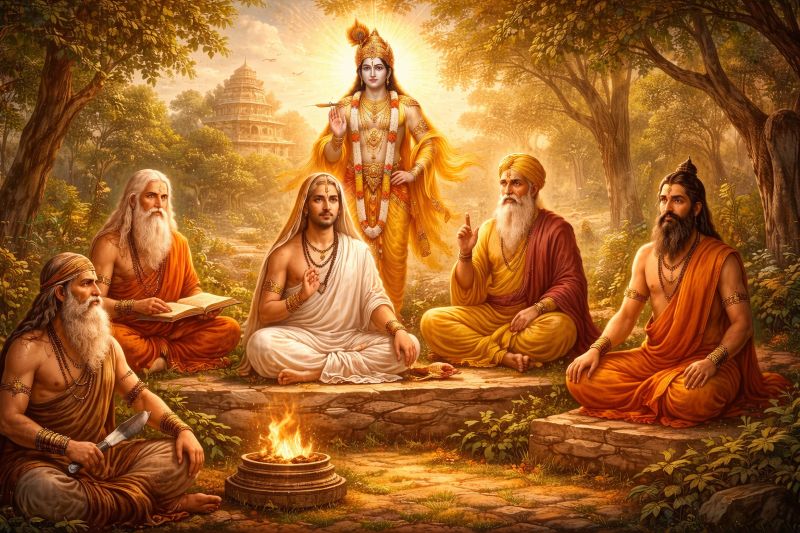
Hindu Dharma (Sanatan Dharma) is not limited to the worship of gods and goddesses alone. Its living soul lies in the Rishis (sages) and Gurus (spiritual teachers) who, across thousands of years, have guided humanity toward morality, self-knowledge, and liberation. While deities represent the highest spiritual ideals, it is the Rishis and Gurus who showed humanity how to reach those ideals in real life.
Their teachings, discipline, and wisdom shaped not only religious thought but also daily life, society, ethics, and human values. Even today, their guidance remains deeply relevant.
Rishis and Gurus: Meaning and Role
Who is a Rishi?
A Rishi is an enlightened seer who realized eternal truth through deep meditation, austerity, and inner vision. Rishis are known as the bearers of Shruti, meaning they “heard” divine truths during deep states of awareness and passed them on to humanity.
The foundations of the Vedas, Upanishads, Puranas, and the Mahabharata rest upon the realizations of these great sages. They did not invent truth—they discovered it.
Who is a Guru?
A Guru is a spiritual guide who leads a seeker from ignorance to knowledge, from darkness to light. A Guru does not merely teach scriptures; he shapes character, clarity, and inner discipline.
The word Guru itself explains this role:
-
Gu = darkness
-
Ru = remover
A Guru shows how spiritual wisdom can be lived, not just understood.
Historical Role of Rishis and Gurus in Hindu Dharma
Throughout history, Rishis and Gurus have played a decisive role in shaping Hindu civilization. Their teachings were not confined to temples or forests—they influenced families, societies, governance, and moral conduct.
They established values such as:
-
Dharma (righteous duty)
-
Compassion
-
Self-restraint
-
Balance between power and morality
Major Rishis and Gurus of Hindu Dharma
1. Rishi Vedavyasa (Vyasa)
Rishi Vyasa stands as one of the greatest pillars of Hindu Dharma.
His contributions include:
-
Composition of the Mahabharata
-
Systematic compilation of the Vedas
-
Composition of the Puranas
-
Preservation of Bhagavad Gita, which appears within the Mahabharata
The Bhagavad Gita presents a perfect synthesis of action, devotion, and knowledge, offering guidance that remains relevant even today.
Reference: Mahabharata, Bhishma Parva
2. Rishi Vishwamitra
Rishi Vishwamitra is the seer of the Gayatri Mantra, one of the most sacred mantras of Hindu Dharma.
His life is extraordinary—he was born a king but, through intense penance and discipline, rose to the status of a Brahmarishi. His journey proves that spiritual greatness depends on effort, not birth.
Reference: Rig Veda 3.62.10 (Gayatri Mantra)
3. Parashurama
Parashurama represents the unique union of Brahmin wisdom and Kshatriya strength. His life teaches that power must always be guided by morality and justice.
He stood for righteousness and the protection of Dharma, showing that strength and ethics can coexist.
4. Adi Shankaracharya
Adi Shankaracharya revived and systematized Advaita Vedanta, the philosophy of non-duality.
Key teachings:
-
The soul (Atman) and the ultimate reality (Brahman) are one
-
Division is an illusion created by ignorance
-
Liberation comes through knowledge and realization
He wrote influential commentaries on the Upanishads, Bhagavad Gita, and Brahma Sutras, uniting philosophy with spiritual practice.
Reference: Brahma Sutra Bhashya, Gita Bhashya
5. Guru Nanak
Although Guru Nanak founded Sikhism, his teachings strongly resonate with Sanatan values.
He emphasized:
-
One universal God
-
Equality of all humans
-
Rejection of caste, gender, and religious divisions
-
Service to humanity as true religion
His teachings bridge spiritual traditions and promote universal human values.
Core Philosophy of Rishis and Gurus: The Four Yogas
1. Jnana Yoga – The Path of Knowledge
Jnana Yoga focuses on self-knowledge and understanding reality as it truly is.
The Bhagavad Gita (Chapter 13) explains the difference between:
-
The temporary body and emotions
-
The eternal soul (Atman)
Real-life example:
Stepping back from emotional reactions and seeing situations with clarity.
2. Karma Yoga – The Path of Action
Karma Yoga teaches selfless action without attachment to results.
Bhagavad Gita 2.47:
“You have the right to perform your duty, but not to the fruits of action.”
Real-life example:
Doing one’s work honestly and sincerely, regardless of reward or recognition.
3. Bhakti Yoga – The Path of Devotion
Bhakti Yoga is the path of love, surrender, and emotional connection with the Divine.
Bhagavad Gita 9.26:
A simple offering given with devotion is accepted by God.
Real-life example:
Living with humility, gratitude, and faith rather than ego.
4. Raja Yoga – The Path of Meditation
Raja Yoga focuses on mental discipline and inner peace through meditation.
A calm mind leads to better decisions, emotional balance, and spiritual growth.
Real-life example:
Regular meditation reducing stress and anxiety in daily life.
Spiritual Practices of Rishis and Gurus
Their spiritual discipline included:
-
Meditation for inner clarity
-
Mantras to elevate consciousness
-
Tapasya (austerity) for self-control and focus
These practices were tools for self-realization, not rituals for display.
Social and Global Impact
The teachings of Rishis and Gurus:
-
Promoted justice, compassion, and tolerance
-
Connected spirituality with service to humanity
-
Influenced global philosophy, ethics, and psychology
Their wisdom crossed religious and cultural boundaries.
Relevance in the Modern World
In today’s fast-paced, technology-driven life:
-
Stress, confusion, and moral conflict are increasing
-
Teachings of Rishis and Gurus offer balance and purpose
Example:
A student facing exam pressure can use Karma Yoga to focus on effort instead of fear.
Scriptural Authenticity and References
-
Mahabharata (Bhishma Parva)
-
Bhagavad Gita (critical editions)
-
Upanishads
-
Commentaries by Shankaracharya, Ramanujacharya, Madhvacharya
Conclusion
The Rishis and Gurus of Hindu Dharma taught that religion is not merely ritual—it is conscious living. Their teachings awaken the human spirit and guide individuals toward truth, compassion, and responsibility.
They are not figures of the past—they are guides for the present and foundations for the future.
Saints and Gurus of Hindu Dharma are not just history;
they are the living path of humanity itself. 🕉️