

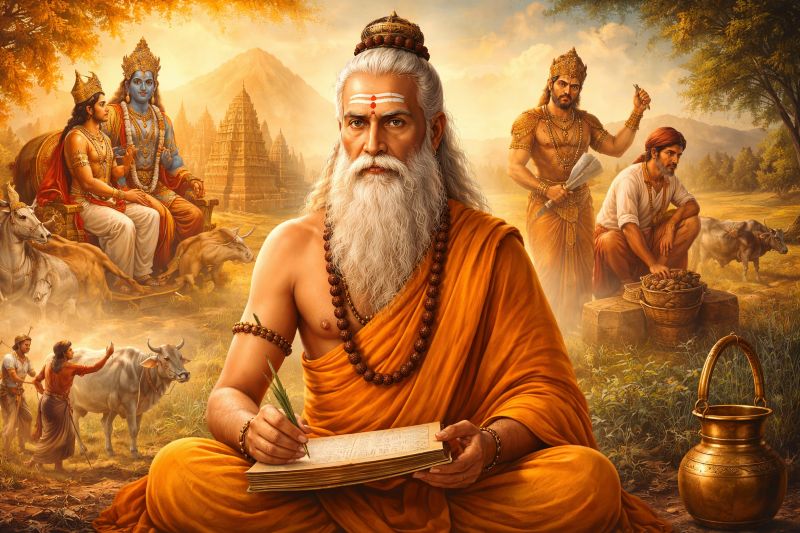
Is a Brahmin Biological? Birth, Qualities, Actions, and the True Meaning of Dharma
Many people today are confused.
They ask:
-
“Is someone a Brahmin by birth?”
-
“Is the Bhagavad Gita right, or Manusmriti?”
-
“Did people really come from the mouth, arms, or feet of a cosmic being?”
The answers exist in the scriptures—but only when they are read completely, not in fragments.
1. Is Brahmin a biological identity?
No.
No Hindu scripture says that a Brahmin is defined by blood, genes, or family lineage.
Lord Krishna clearly states:
“The four social divisions were created by Me based on qualities and actions.”
— Bhagavad Gita 4.13
This means human roles are determined by one’s nature (guna) and one’s work (karma)—not by birth.
If caste were biological, Krishna would have used the word birth. Instead, he used qualities and actions.
2. What does “Guna” really mean?
Guna refers to a person’s mental and moral nature.
According to the Gita and Sankhya philosophy, there are three fundamental qualities:
| Guna | Meaning |
|---|---|
| Sattva | wisdom, purity, self-control |
| Rajas | activity, ambition, leadership |
| Tamas | ignorance, laziness, confusion |
A person who lives with knowledge, truth, and self-discipline is Brahmin in nature, regardless of birth.
3. Why do Purānas and Manusmriti talk about birth?
Because they describe social structure, not eternal spiritual truth.
Manusmriti itself says:
“By birth everyone is a Shudra; through discipline and knowledge one becomes twice-born.”
— Manusmriti 2.16
This means status comes from learning, character, and conduct, not from family.
So Manusmriti does not contradict the Gita—it supports it.
4. Which is higher: Gita or Manusmriti?
Hindu scripture has a clear hierarchy:
| Level | Text |
|---|---|
| 1 (Highest) | Vedas & Upanishads |
| 2 | Bhagavad Gita |
| 3 | Smritis (Manusmriti, Purānas) |
Even Manusmriti states that if a Smriti contradicts the Vedas, it must be rejected.
The Gita expresses the philosophical truth of the Vedas.
Smritis apply those truths to social life.
So for spiritual truth, the Gita is final.
5. Did humans come from feet, arms, or mouths?
No. That description is symbolic, not literal.
The Purusha Sukta (Rig Veda 10.90) uses body parts to describe social functions, not physical birth:
| Body part | Meaning |
|---|---|
| Mouth | knowledge & teaching (Brahmin) |
| Arms | protection & leadership (Kshatriya) |
| Thighs | trade & economy (Vaishya) |
| Feet | service & labor (Shudra) |
It explains how society works—not how babies are born.
Even science agrees: humans are born biologically, not from body parts.
6. What does history show?
If birth were final, then these people could never have risen:
| Person | Birth | Identity |
|---|---|---|
| Valmiki | bandit family | great sage |
| Vyasa | fisherwoman’s son | Vedic master |
| Vidura | servant’s child | greatest statesman |
They became great through character and effort, not lineage.
Final Truth
✔ A Brahmin is not a gene
✔ Varna is based on qualities and actions
✔ Birth only provides environment, not identity
✔ The Gita and Upanishads are the highest authority
✔ Smritis describe society, not eternal truth
Conclusion
Sanātana Dharma is not about bloodlines.
It is about character.
Varna is not pride—it is responsibility.
True identity is not inherited—it is earned.
